
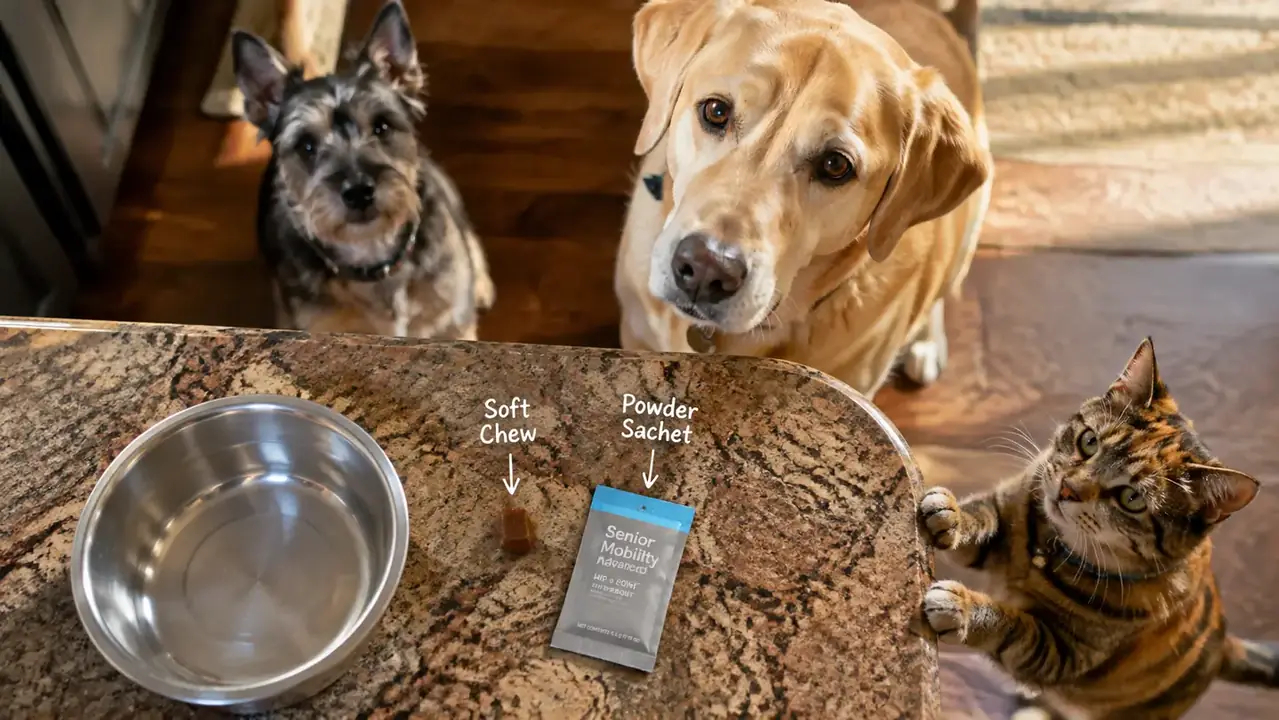
Millie is my nine-year-old terrier mix, and up until this spring she had never once had a stomach issue in her life. Then I switched her dog food too fast, my own fault, I know better after twelve years of doing this, and I spent two weeks cleaning up loose stool in the backyard here in Ocala. My vet's first suggestion wasn't a prescription. It was a probiotic. So I ended up running both PetLab Co. Probiotic Chews and Purina FortiFlora, back to back, over about ten weeks, because Millie is not the world's most food-motivated dog and I needed to know which one she would actually eat versus which one would just sit in the pantry collecting dust.
Here is the honest side by side. Chew versus powder, real results, no rounding up.
The Short Answer
If you want something that feels like a treat and takes zero prep, PetLab Co. Probiotic Chews win on convenience and on getting a picky dog to actually finish the full dose. If you want the exact single strain your vet may have specifically named, or you're feeding more than one dog and portioning a powder into separate bowls is simpler than counting out chews by weight, FortiFlora earns its spot too. Neither one fixed Millie's stomach on its own. Feeding her the same food consistently, without me second-guessing and switching brands again, did most of the actual work. The probiotic supported that. It didn't replace it, and I'd be lying to you if I said otherwise.
How I Tested Both
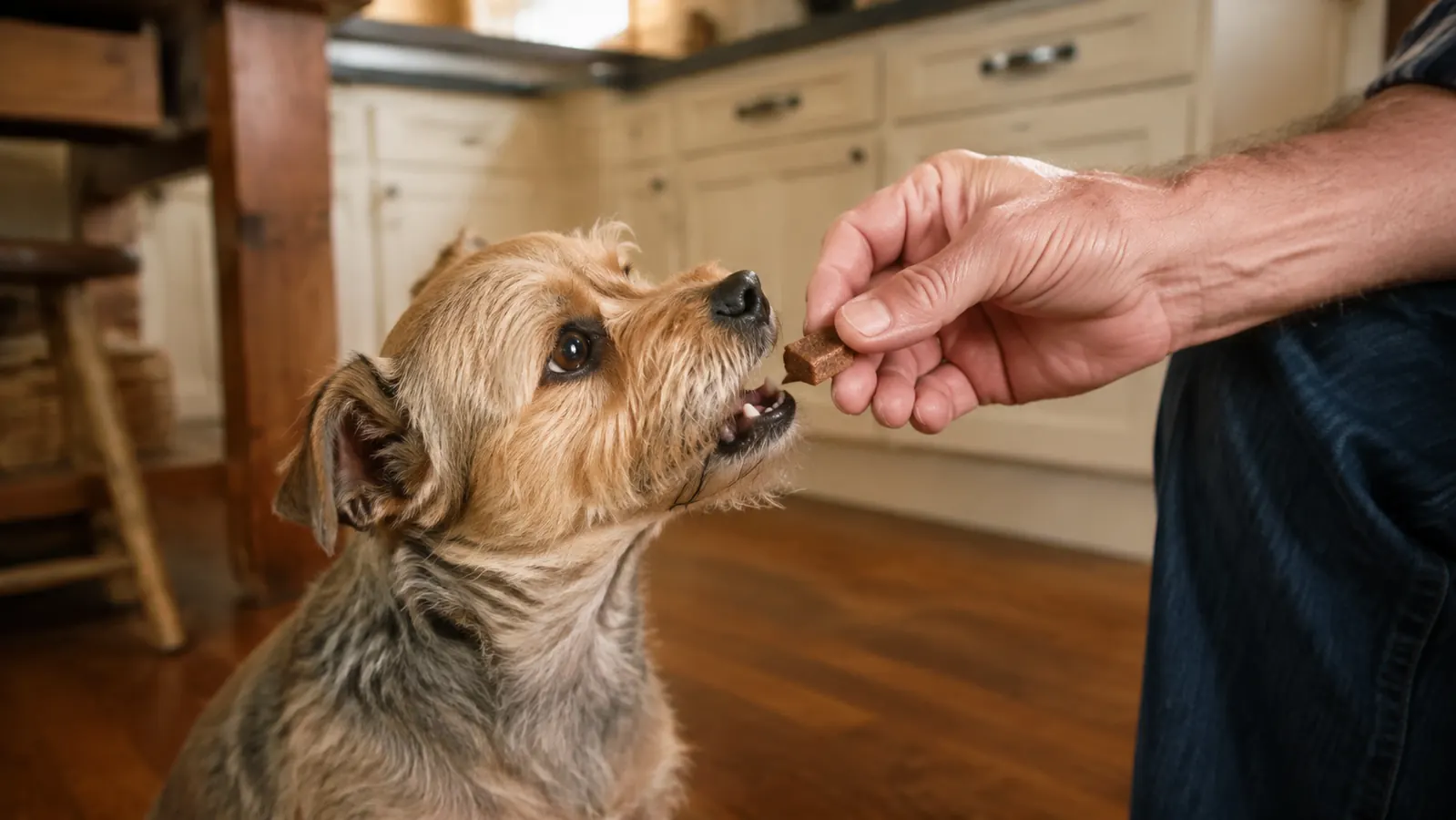
I gave Millie the PetLab Co. chews for four weeks first, one chew a day tucked in with her evening meal, and I tracked it in an actual notebook because I don't trust myself to remember details a month later. Then I gave her a two-week break so her gut could settle back toward baseline before I introduced anything new. After that I ran FortiFlora for four weeks, one sachet a day mixed into a spoonful of wet food, exactly per the label. Same dry food both times, same walk schedule, same treats otherwise, same everything I could reasonably keep constant.
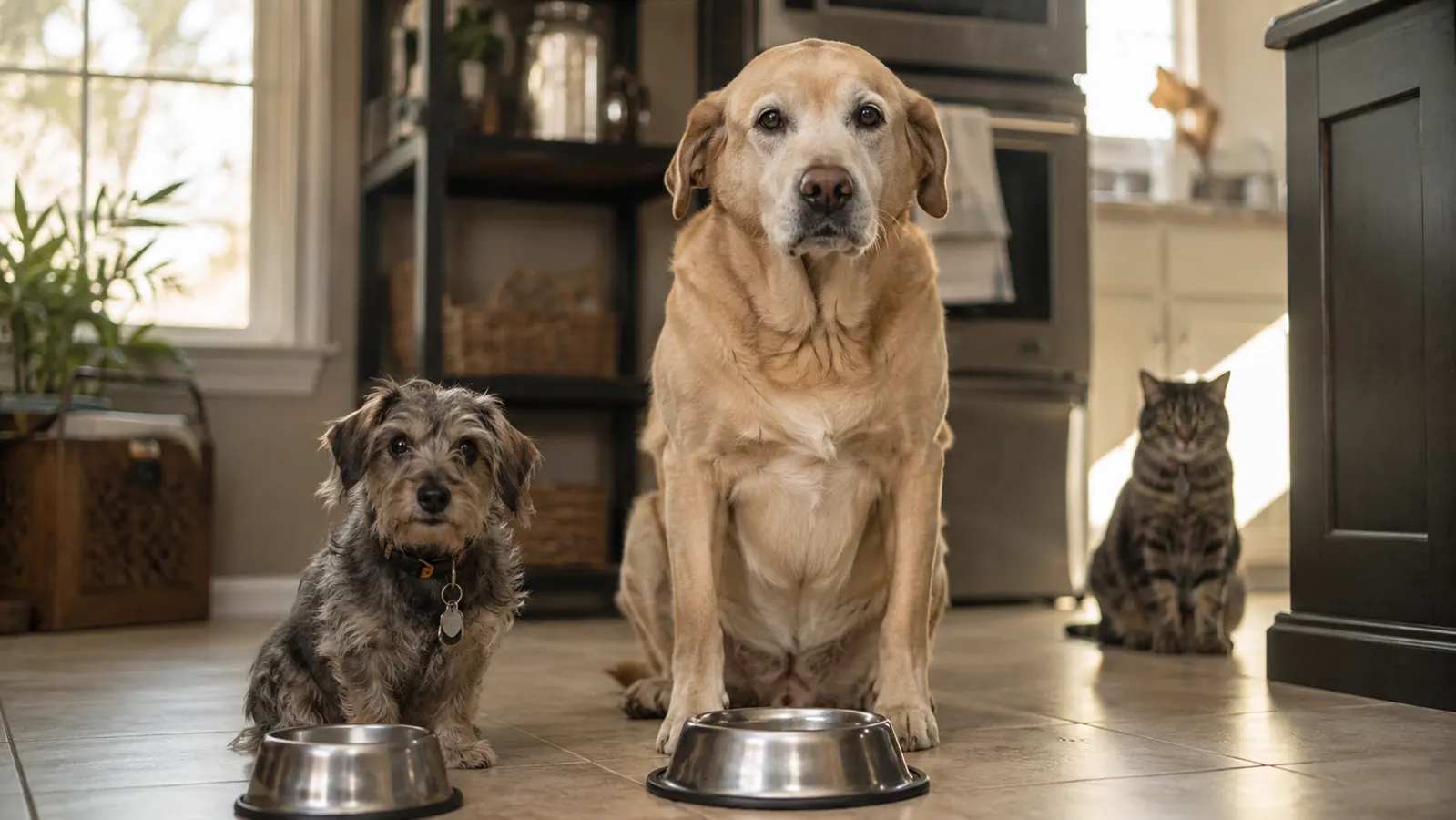
I was watching for three things: stool consistency, whether she'd eat the dose willingly without me hiding it in something stronger smelling, and any gas or bloating the next morning. Gus, my twelve-year-old Lab mix, doesn't have digestive issues so he wasn't part of the actual test, but he did get to lick the spoon after I mixed the FortiFlora sachets each morning, which he personally considered the best part of the whole ten weeks. Pearl, my ten-year-old cat, wanted nothing to do with any of it and made that extremely clear from the top of the refrigerator.
What Else I Noticed Along the Way
Stool consistency was the headline metric, but it wasn't the only thing that changed. About two and a half weeks into the PetLab Co. chews, I noticed Millie's morning gas had all but disappeared, which was a genuine relief given how small my kitchen is and how close her bed sits to it. Her appetite stayed steady the whole month, no picky mornings, no leaving food in the bowl. That matters more than it sounds like it should, because a dog who suddenly goes off her food is usually the first sign something's actually wrong, and I was grateful I never had to second-guess whether the supplement itself was the problem.
The FortiFlora month looked a little different. The first several days, Millie was hesitant about the texture mixed into her food, sniffing it longer than usual before committing to eat, which I hadn't expected from a dog who normally inhales her meals. By the second week she'd adjusted and ate normally again. Her stool did improve on FortiFlora too, just a few days slower to firm up than it had on the chews, which could easily be coincidence given it wasn't a scientific trial, just one dog, one household, and my own notebook.
| PetLab Co. Probiotic Chews | FortiFlora | |
|---|---|---|
| Form | Soft chew that tastes like a treat, no mixing or measuring required | Powder sachet, must be mixed into wet or moistened food |
| Strain approach | Multiple probiotic strains plus prebiotic fiber and added digestive enzymes in one chew | A single targeted strain, Bifidobacterium animalis, the same one a lot of vets already reach for |
| Picky eater acceptance | Millie ate it straight from my hand every single time, all ten weeks | Millie sniffed the powder and walked off twice until I mixed it into something with more smell |
| Vet-brand recognition | A newer supplement brand, not something most vets bring up by name | The one my own vet named specifically, and the one you'll see stocked in a lot of clinics |
| Multi-dog households | Fixed one-chew dose, awkward to split for a very small or very large dog | Powder scoops easily to a smaller or larger portion for dogs of different sizes |
| Cost to run daily | Roughly the same daily cost as FortiFlora, chew for chew | Roughly the same daily cost as PetLab Co., sachet for sachet |
| Best for | One dog, feeding at home, want a set-it-and-forget-it daily treat | Multi-dog households, or when a vet has specifically recommended FortiFlora by name |
Where PetLab Co. Wins
The chew format is the whole story here. I did not have to mix anything, measure anything, or trick Millie into eating it. I opened the bag, handed her one, and she took it like a treat every single morning of the four weeks, no exceptions. For a dog who has turned her nose up at powders, pills, and pretty much anything that smells like medicine since she was a puppy, that matters more than any ingredient list. There was also less mess. No powder residue left in her bowl, nothing that dried into a crust I had to scrub off in the sink.
The multi-strain, multi-ingredient formula also gave me some peace of mind, not because I could measure the difference in strain diversity myself at home, but because it meant I wasn't relying on a single organism doing all the work. By week three her stool had firmed up noticeably, and by week four it was back to normal, which was faster than I expected honestly. PetLab Co. is also the one I ended up sticking with after the test, mostly because Millie's compliance was perfect and I never had a morning where I had to coax her into eating breakfast because something in the bowl smelled off to her.
Where FortiFlora Wins
FortiFlora has one thing PetLab Co. doesn't, and it's not small: it's the probiotic my own vet named specifically when I described what was going on with Millie. That kind of clinical familiarity counts for something, especially if your dog has a diagnosed condition or you're working alongside a vet who wants a specific, well-studied strain rather than a broader blend. If Millie had needed something more targeted, or if my vet had wanted to track a single variable, FortiFlora would have been the more precise tool for that job.
It also flexes better across a multi-dog household. If I had a second dog needing a smaller dose, or a much bigger dog needing more, the powder scoops to whatever amount makes sense. A chew is a chew, one fixed dose, which is simple until it isn't the right size for the animal in front of you. And practically speaking, a sachet travels flatter in a suitcase or a boarding bag than a resealable pouch of chews does, which sounds minor until you're the one packing for a week at the kennel.
See Today's Price on PetLab Co. Probiotic Chews
The chew format is what actually got Millie's stomach back on track without a fight at breakfast every morning.
Amazon Check Today's Price on Amazon →By week three her stool had firmed up noticeably, and by week four it was back to normal, faster than I expected.
Ingredients and Strains: What's Actually in Each
PetLab Co. Probiotic Chews list multiple probiotic strains on the label along with prebiotic fiber and digestive enzymes, all built into one soft chew. The idea behind a blend like that is breadth, more than one organism working through the gut at once, plus the prebiotic fiber that's meant to feed the good bacteria already living there. I'm not a vet and I'm not going to pretend I can independently verify strain-by-strain efficacy from my kitchen table. What I can tell you is what I watched happen in Millie's stool and behavior over four weeks, and that's the honest limit of what this review can claim.
FortiFlora is built differently, one strain, Bifidobacterium animalis, delivered in a much smaller daily dose. It's been around longer and it's the one a lot of vets already know by name, which is worth something even before you open the box. Neither approach is wrong. A single well-studied strain has its own logic, and a broader blend has its own logic. If your dog has a specific diagnosis, ask your vet which approach they'd rather you use before you pick based on convenience alone, because that's a call that should come from someone who's actually examined your dog.
Can You Use Both, or Switch Back and Forth
I get asked this a lot now that people know I ran both. My honest answer is that I stuck to one at a time during the test on purpose, since running them together would have made it impossible to tell which one was actually doing anything. If you want to combine a probiotic chew with a vet-recommended powder, or switch between the two depending on the season or what's in your pantry, that's a conversation to have with your vet first, especially if your dog has any ongoing digestive condition. For a healthy dog without a diagnosed issue, most vets are fine with either one used consistently on its own. Doubling up without asking isn't something I'd recommend just because I happened to have both bottles open on my counter.
Cost, Without the Sticker Numbers
I'm not going to quote you exact figures here because pricing shifts constantly and whatever I typed today would be stale by the time you read this. What I can tell you from running both for a full month each is that the day-to-day cost of feeding either one was close enough that it never became the deciding factor in my house. Check today's listed price before you buy either one, since that's the only number that's actually current.
What mattered more than the cost was whether Millie would actually eat the dose without a fight, because a probiotic that ends up untouched in the bowl isn't saving anyone anything, no matter what it costs. That's really the whole argument for the chew format in a single sentence.
Who Should Buy Which
If you've got one dog, you're feeding at home, and you want something that goes down easy as a daily treat with zero prep, get the PetLab Co. chews. That's what worked for Millie and what I've kept buying since the test ended. If your vet has specifically recommended FortiFlora, or you're managing more than one dog and need to adjust doses by size, or your dog has a diagnosed digestive condition being monitored by a vet, FortiFlora is the more precise choice and you should follow your vet's guidance over mine. Either way, a sudden or ongoing change in stool, appetite, or energy is a vet visit, not a supplement decision, and I'd tell you that even if I weren't required to.
Months later, Millie is still on the PetLab Co. chews, and her stool has stayed normal since that first month I ran the test. Gus gets his own joint chews at dinner, Pearl gets absolutely nothing because cats have opinions about supplements, and the whole feeding routine takes about ninety seconds longer than it used to, which is a trade I'll happily make.
Check Today's Price and Availability
PetLab Co. Probiotic Chews were the easier daily habit to actually stick with in my house, and Millie never once turned one down.
Amazon Check Today's Price on Amazon →