

My cat Pearl turned ten this spring, and at her wellness exam my vet lifted her lip, made that little humming sound vets make when they're being diplomatic, and said the word I'd been dreading: tartar. Nothing urgent, she said, but enough that if I ignored it for another year we'd probably be scheduling a dental cleaning under anesthesia, and at Pearl's age that's not a decision I take lightly, between the bloodwork, the recovery, and the cost of the whole thing. I'd already tried the things people tell you to try. A finger toothbrush she tolerated for exactly four seconds before clawing my hand and stalking off to sulk under the bed. A water additive she sniffed once and then avoided her whole water bowl for two days, which is its own kind of problem in a ten-year-old cat who needs to stay hydrated. None of it stuck, because none of it fit how Pearl actually lives, which is that she eats when she decides to eat and tolerates almost nothing forced on her.
That's where Greenies Feline Dental Treats came in. This is what six months of giving them to her every single day actually looked like: her tartar, her breath, whether she kept eating them past week two, and the one thing about the bag I wish I'd understood sooner.
The Quick Verdict
A treat Pearl genuinely asks for that made a visible difference in her tartar and breath by month three, docked half a star for how easily the calories add up if you're not paying attention.
Amazon Check Today's Price →See Today's Price on the Same Bag I Buy Pearl
Roasted chicken flavor, 4.6 oz. At Pearl's daily dose, one bag runs about a month.
Amazon Check Today's Price on Amazon →How I've Used It
Pearl weighs a little under nine pounds, so I give her two treats a day, one in the morning after her wet food and one right before bed. That's the range printed on the Greenies bag for cats her size, but I still ran it past my vet before starting, since Pearl also gets a small daily joint supplement and I wanted to be sure the extra calories wouldn't add up in a way that mattered for an indoor cat who sleeps most of the day and doesn't burn much off.
The texture is dry and crunchy, nothing like her usual wet food, and that crunch is really the whole mechanism. The treat is meant to scrape against the tooth surface as she chews rather than just sitting there being a flavored snack. I noticed early on that Pearl actually crunches through hers instead of gulping them whole the way she does with some soft treats, which made me trust the mechanism a little more than I expected to going in.
I kept the timing consistent on purpose, same two windows every day, because Pearl is a creature of habit and I wanted this to become part of her routine rather than something I remembered to do some days and forgot on others. Consistency turned out to matter more than I initially gave it credit for, and it's honestly the biggest reason this stuck where the toothbrush and the water additive didn't. I never had to chase her down or hold her still for it.
I also switched where I keep the bag, right on the counter next to her food canister instead of tucked in a cabinet, because if it's out of sight it's out of my routine too. Small thing, but six months in, that placement is probably the real reason I never missed more than one or two nights the whole stretch.
The First Six Weeks: Tartar, Breath, and a Skeptical Cat
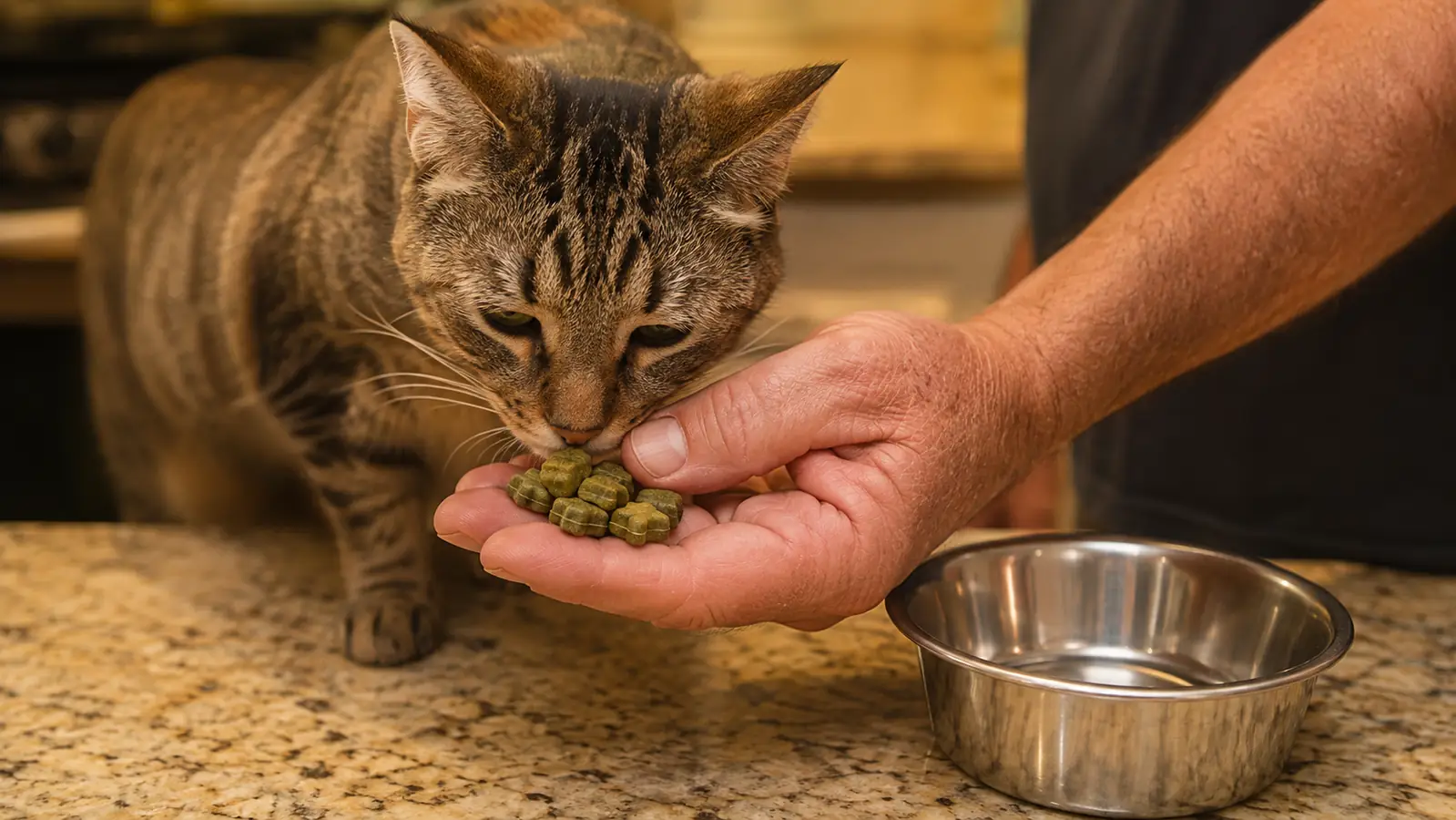
Week one was rocky. Pearl is suspicious of new food in general, and the first night she sniffed the treat, batted it across the kitchen floor, and walked away. I almost gave up right there, since that's exactly what happened with the water additive too. But I left it in her regular spot and tried again the next morning, and by day four she was eating them without hesitation, though still not with any enthusiasm.
By week three something shifted. Pearl started meeting me in the kitchen around eight every night, which is exactly when I hand her the second treat. That's more consistency than I've ever gotten out of any supplement I've tried to sneak into her routine, and it told me the chicken flavor was doing real work in terms of getting her to actually want this rather than just tolerate it.
The breath change was the first thing I noticed personally. Pearl's breath had that faint fishy edge you get from wet food, and by about week five it was noticeably milder when she yawned near my face, which she does constantly and without warning, usually about six inches from my nose while I'm on the couch. I want to be careful here: this is what I smelled, not a lab result, and I'm not a vet. But it was consistent enough, day after day, that I stopped bracing for it.
What's Actually in the Bag
Chicken is the first ingredient, which explains why Pearl took to the flavor faster than she took to the water additive or the toothbrush. The bag also lists chlorophyll, which is the ingredient most dental treats lean on for breath, and a blend built around that dry, textured kibble shape designed to create friction against the tooth as the cat chews rather than just being swallowed like a soft treat.
The Greenies packaging notes acceptance from the Veterinary Oral Health Council for helping control plaque and tartar when used as directed, which is a real, independently reviewed seal, not marketing language Greenies invented themselves. I'm not going to tell you it replaces a dental cleaning or that it treats any diagnosed condition, because it doesn't and I'm not qualified to make that call anyway. What I can tell you is what I watched happen in my own cat's mouth over six months, and I'll get to that.
One thing worth knowing going in: this is a treat, not a meal replacement, and it's meant to sit alongside her regular diet, not instead of it. I didn't cut back Pearl's usual food to make room for the treats. I just factored the extra calories into how much wet food I was already giving her, which took maybe a week of paying closer attention to get right, mostly by reading the calorie count on both bags side by side and doing the math once so I didn't have to think about it every day after.
The Week I Left Her With a Pet Sitter
Month four tested the routine in a way I hadn't planned for. My sister in Gainesville needed help after a minor surgery, and I ended up gone for eight days, which meant handing Pearl's care over to a neighbor who'd only ever fed her before, never done the dental treats. I taped a note to the fridge with the exact schedule, morning and night, two treats, the bag on the counter by her food canister, and I texted a photo of the bag so there was no confusion about which one I meant. I'll admit I worried the whole time I was gone, not about Pearl's health exactly, but about whether eight missed nights would undo whatever progress we'd made, and whether I'd come home to a cat who'd lost interest in the treats entirely after a week off her routine.
It held. My neighbor kept the note on the fridge and texted me a photo of Pearl crunching a treat on day three, tail up, no hesitation, which told me the habit had become Pearl's, not just mine. When I got home her breath was where it had been before I left, not worse, and she met me at the door and then walked straight to the kitchen counter like she was reminding me it was past eight o'clock. That week did more to convince me this was a real routine, and not just something that worked because I was the one doing it, than any of the first six weeks had.
The Chlorophyll Question I Finally Asked My Vet
At Pearl's five-month exam, once we'd covered the tartar and the lump that turned out to be nothing, I asked my vet directly what chlorophyll actually does for a cat's breath, since it's the ingredient every dental treat bag seems to lean on and I'd never gotten a straight answer anywhere online. She was candid about it. Chlorophyll has some deodorizing properties, she said, but for a treat like this, most of the real dental benefit is mechanical, the crunch and the chewing motion scraping the tooth surface, not the ingredient sitting in the treat's marketing copy. She was clear she wasn't speaking for Greenies specifically, just explaining the general science behind why dental chews are shaped and textured the way they are.
That conversation recalibrated what I'd been crediting for Pearl's milder breath. I'd assumed the chlorophyll was doing more of the work than it probably was, when really it's the daily chewing habit itself, consistent, twice a day, month after month, that seems to matter most. It didn't change whether I'd keep buying the bag, but it did change how I'd explain this to a friend asking whether the ingredient list matters. My honest answer now is that the routine matters more than any single line on the label, chlorophyll included.

Six Months In: What Actually Changed
Pearl had a follow-up exam around the five-month mark, mostly unrelated, a lump my vet wanted to keep an eye on that turned out to be nothing. But while she had Pearl's mouth open anyway, she mentioned that the tartar along the gumline looked lighter than it had at the spring visit. She was careful to say it's not a substitute for professional cleanings and that she'd still want to reassess at Pearl's next full exam, and I appreciated that she didn't oversell it. But hearing an actual vet volunteer that observation, unprompted, meant more to me than anything on the Greenies bag.
Six months of daily treats hasn't turned Pearl's mouth into something out of a toothpaste commercial, and I didn't expect it to. What changed is smaller and more livable: her breath stays manageable between exams, she has a treat she genuinely looks forward to instead of one I have to hide in something else, and I have a daily habit that's actually stuck, which after years of failed toothbrushes and abandoned water additives is not nothing.
I also weighed her monthly through this whole stretch, mostly out of caution about the added calories, and her weight has stayed within about two ounces of where it started. That's the range my vet said was fine for a cat her size and age, so the extra treats haven't been the problem I worried they might be, but I did have to actually track it rather than assume it would sort itself out on its own.
Who Should Buy This, and the Catch With Calories
The catch, and it's a real one, is that these treats are easy to overdo. Each one carries real calories, and it's tempting to hand out a few extra when your cat is doing that insistent meowing-at-the-cabinet thing. For a smaller or older cat like Pearl, that adds up faster than it would for a younger, more active cat, so I'd treat the dosing guide on the bag as a starting point to check against your vet, not a number to eyeball. I now portion Pearl's two treats out at the start of the week into a small dish so I'm not eyeballing the bag itself, which sounds fussy but takes about ninety seconds on a Sunday and keeps me honest.
The other thing to know before buying is that this works best as a routine, not an occasional thing. The tartar and breath changes I saw came from Pearl getting these twice a day, every day, for months. If you're the kind of household where treats get forgotten for a week here and there, the results will be a lot less consistent than what I'm describing, and you might not notice much difference at all.
What I Liked
- Pearl eats these consistently, which none of my previous dental attempts managed
- Noticeably milder breath by around week five, and it's stayed that way
- My vet independently mentioned lighter tartar along the gumline at five months
- Chicken flavor made the daily habit stick where a toothbrush and a water additive both failed
- Easy to fold into an existing routine, no forcing or hiding required
Where It Falls Short
- Calories add up quickly for a smaller or senior cat if you're not tracking dosing
- Not a substitute for a professional cleaning, and my vet was clear about that
- The first week can be rocky if your cat is wary of new food textures
- Doesn't address tartar that's already built up heavily without other care
By week three, Pearl started meeting me in the kitchen every night around eight, the exact time I hand her the second treat, which is more consistency than I've ever gotten out of a supplement.
Who This Is For
This is for cats like Pearl: indoor, middle-aged to senior, prone to the slow tartar buildup that comes with wet food and years of a mostly soft diet, and owned by someone who has already tried brushing or a water additive and had their cat flatly refuse it. If your cat will eat a crunchy treat willingly, this is about as low-friction as dental maintenance gets for a cat that won't sit still for anything more hands-on. I'd also add that this suits owners who want a low-effort daily habit more than a dramatic fix. It's the kind of thing that works precisely because you barely have to think about it once it's part of the evening routine, which for a lot of us is the only kind of health habit that actually survives past the first month.
Who Should Skip It
Skip this, or check with your vet first, if your cat has an existing diagnosed dental condition, is on a strict calorie-controlled or prescription diet, has a known chicken sensitivity, or is a kitten too young for adult dental treats. And if your cat's mouth already shows heavy tartar or any sign of pain when eating, that's a vet visit first, not a bag of treats. This worked as maintenance for a cat with mild, age-typical buildup, not as a fix for a problem that's already there. I'd also skip it, at least for now, if your cat won't reliably chew dry treats at all, since the mechanism only does anything if the treat actually gets crunched rather than swallowed whole or ignored on the floor.
Ready to Try the Same Routine With Pearl
The bag I've bought every month for six months. Check availability and today's price before it's out of stock again.
Amazon Check Today's Price on Amazon →